
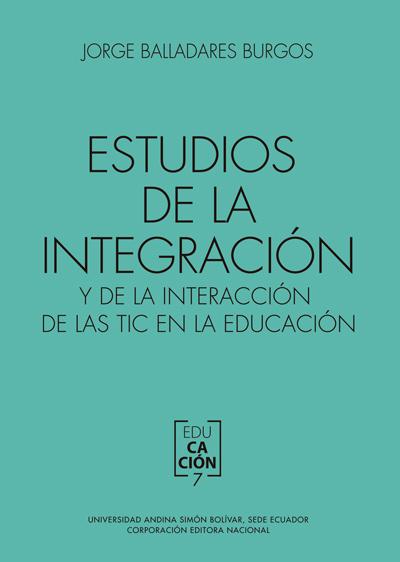
Estudios de la integración y de la interacción de las TIC en la educación
Palabras clave:
Integración, TIC, Educación, Innovación, PedagogíaSinopsis
Este libro presenta dos estudios acerca de la relación entre las tecnologías de la información y la comunicación (TIC) y la educación. El primero indaga la integración de las TIC en la formación del profesorado a partir del modelo tecnoeducativo TPACK. A raíz de la pandemia de COVID-19, se evidencia cierta adaptación de las TIC a los procesos de enseñanza, con el profesorado como actor clave. En el segundo estudio se presentan resultados sobre las relaciones y las interacciones mediadas por la tecnología de los actores de la comunidad educativa a partir del modelo teórico de la Comunidad de Indagación (Col) a través de sus tres presencias: cognitiva, social y de enseñanza. Se espera que ambas investigaciones contribuyan al mejoramiento de los programas de formación del profesorado y de capacitación docente en la incorporación de estos recursos al día a día del aula. Esta obra es una invitación para que las instituciones educativas fomenten el desarrollo de competencias digitales docentes en la formación de su profesorado y cuenten con el apoyo de las tecnologías para el fortalecimiento y expansión de los procesos educativos en la pospandemia.
Descargas
Referencias
Aguilar, Floralba, coord. 2019. Enfoques y perspectivas del pensamiento pedagógico latinoamericano. Quito: Abya-Yala.
Akyol, Zehra, Norm Vaughan y Randy Garrison. 2009. «The impact of course duration on the development of a community of inquiry». Interactive Learning Environments 19 (3): 231-46. http://dx.doi.org/10.1080/10494820902809147.
Amezcua, Angélica, Anel Brandl, Evelyn Durán y Estrella Rodríguez. 2021. «The switch to remote instruction in Spanish heritage language courses: Why social presence matters». E-JournALL, EuroAmerican Journal of Applied Linguistics and Languages 8 (2): 185-214. http://doi.org/10.21283/2376905X.14.249.
Anderson, Terry, Liam Rourke, Randy Garrison y Walter Archer. 2001. «Assessing teaching presence in a computer conference context». Journal of Asynchronous Learning Networks 5 (2): 1-17.
Arbaugh, J. B., Arthur Bangert y Martha Cleveland-Innes. 2010. «Subject matter effects and the Community of Inquiry (CoI) framework: An exploratory study». The Internet and Higher Education 13 (1-2): 37-44.
Arbaugh, J. B., Martha Cleveland-Innes, Sebastian Diaz, Randy Garrison, Philip Ice, Jennifer Richardson y Karen Swan. 2008. «Developing a community of inquiry instrument: Testing a measure of the Community of Inquiry framework using a multi-institutional sample». The Internet and Higher Education 11 (3-4): 133-6. https://doi.org/10.1016/j.iheduc.2008.06.003.
Balbo, Josefina. 2008. Formación en competencias investigativas, un nuevo reto en las universidades. Universidad Nacional Experimental del Táchira. http://www.ucv.ve/fileadmin/user_upload/vrac/documentos/Curricular_Documentos/Evento/Ponencias/Balbo__josefina.pdf.
Balladares, Jorge. 2017. «Una ética digital para las nuevas generaciones digitales». Revista PUCE, 104. https://bit.ly/2qUeJzl.
––––. 2018. «Diseño pedagógico de la educación digital para la formación del profesorado». RELATEC. Revista Latinoamericana de Tecnología Educativa 17 (1): 41-60. doi:10.17398/1695-288X.17.1.41.
––––. 2020. «Una educación remota en tiempos de contingencia académica». Andina 2 (II semestre): 29-35. http://hdl.handle.net/10644/7399.
––––. 2021. Educación digital y formación del profesorado en modalidad semipresencial y virtual (b-learning y e-learning). Estudios de caso. Quito: Universidad Andina Simón Bolívar, Sede Ecuador / Corporación Editora Nacional.
Balladares, Jorge, y Jesús Valverde. 2022. «El modelo tecnopedagógico TPACK y su incidencia en la formación docente: una revisión de la literatura». RECIE. Revista Caribeña de Investigación Educativa 6 (1): 63-72. https://doi.org/10.32541/recie.2022.v6i1.pp63-72.
Bangert, Arthur. 2009. «Building a validity argument for the community of inquiry survey instrument». Internet and Higher Education 12 (2): 104-11.
Boyer, Ernest. 1990. Scholarship reconsidered: priorities of the Professoriate. Nueva Jersey: Carnegie Foundation for the Advancement of Teaching.
Cabero, Julio, Verónica Marín y Carlos Castaño. 2015. «Validación de la aplicación del modelo TPACK para la formación del profesorado en TIC». @TIC. Revista d´innovació educativa (Universidad de Valencia): 13-22.
Camacho, Maria, Martin Valcke y Katherine Chiluiza. 2017. «The effect of “research based learning activities” on students’ intention to do research in graduate courses». EduLearn 17 Proceedings, 6571-9. http://www.doi.org/10.21125/edulearn.2017.2497.
Chai, Ching, Joyce Koh y Chin-Chung Tsai. 2013. «A review of technological pedagogical content knowledge». Education Technology and Society 16 (2): 31-51.
Cleveland-Innes, Martha, y D. R. Garrison, eds. 2010. An Introduction to Distance Education: Understanding Teaching and Learning in a New Era. Londres: Taylor & Francis.
Cobo, Cristóbal, y John Moravec. 2011. Aprendizaje invisible. Hacia una nueva ecología de la educación. Barcelona: Publicacions i Edicions de la Universitat de Barcelona.
De Marzio, Darryl. 2017. «Matthew Lipman’s Model Theory of the Community of Inquiry». Analytic Teaching and Philosophical Praxis 38 (1): 37-46.
Dunlap, Joanna, y Patrick Lowenthal. 2014. «The power of presence: Our quest for the right mix of social presence in online courses». En Real life distance education: Case studies in practice, editado por A. A. Piña y A. P. Mizell, 41-66. Greenwich, CT: Information Age Publishing.
Esquivel, Ismael. 2014. Los modelos tecno-educativos, revolucionando el aprendizaje del siglo XXI. Veracruz: Universidad Veracruzana.
Fernández-Sánchez, Rosa, y Jesús Valverde-Berrocoso. 2014. «A community of practice: An intervention model based on computer supported collaborative learning». [Comunidades de práctica: un modelo de intervención desde el aprendizaje colaborativo en entornos virtuales]. Comunicar XXI (42): 97-105. https://doi.org/10.3916/C42-2014-09.
Garrison, D. R., y T. Anderson. 2003. E-learning in the 21st century: A framework of research and practice. Londres: Routledge Falmer.
Garrison, Randy, Terry Anderson y Walter Archer. 2000. «Critical Inquiry in a Text-based Environment: Computer Conferencing in Higher Education». The Internet and Higher Education 2 (2-3): 87-105. doi:http://dx.doi.org/10.1016/S1096-7516(00)00016-6.
––––. 2001. «Critical Thinking and Computer Conferencing: A Model and Tool to Access Cognitive Presence». American Journal of Distance Education 15 (1): 7-23. doi:http://dx.doi.org/10.1080/08923640109527071.
––––. 2010. «The First Decade of the Community of Inquiry Framework: A retrospective». The Internet and Higher Education 13 (1-2): 5-9. doi:http://dx.doi.org/10.1016/j.iheduc.2009.10.003.
Gill, Lincoln, y Barney Dalgarno. 2017. «A qualitative analysis of pre-service primary school teachers’ TPACK development over the four years of their teacher preparation programme». Technology, Pedagogy and Education 26 (4): 439-56. https://doi.org/10.1080/1475939X.2017.1287124.
Goda, Yoshiko, y Masaroni Yamada. 2013. «Application of CoI to design CSCL for EFL online asynchronous discussion». En Educational communities of inquiry: Theoretical framework, research and practice, editado por Z. Akyol y D. R. Garrison. Hershey, PA: IGI Global.
Harris, Judith B., y Mark J. Hofer. 2017. «“TPACK Stories”: Schools and School Districts Repurposing a Theoretical Construct for Technology-Related Professional Development». Journal of Research on Technology in Education 49 (1-2): 1-15. DOI:10.1080/15391523.2017.1295408.
Hermann, Andrés. 2011. «Pedagogía del ciberespacio». Sophia, colección de Filosofía de la Educación 11 (2): 123-74. doi:10.17163/soph.n11.2011.04.
Huggins, Richard, Alan Jenkins y David Scurry. 2007. Undergraduate research in selected US Universities. Report on US Visit. Institutional Case Studies. Oxford Brookes University.
Kiray, Seyit, Ismail Çelik y Mustafa Çolakoğlu. 2018. «TPACK Self-efficacy perceptions of science teachers: A structural equation modeling study». Egitim ve Bilim 43 (195): 253-68. https://doi.org/10.15390/EB.2018.7538.
Koh, Joyce, y Ching Chai. 2014. «Teacher clusters and their perceptions of technological pedagogical content knowledge (TPACK) development through ICT lesson design». Computers & Education 70: 222-32.
––––, Ching Chai y Lee Tay. 2014. «TPACK-in-Action: Unpacking the contextual influences of teachers’ construction of technological pedagogical content knowledge (TPACK)». Computers & Education 78: 20-9.
––––, Ching Chai y Wei Ying Lim. 2017. «Teacher Professional Development for TPACK-21CL: Effects on Teacher ICT Integration and Student Outcomes». Journal of Educational Computing Research 55 (2): 172-96. https://doi.org/10.1177/0735633116656848.
Krauskopf, Karsten, Teresa Foulger y Mia Kim Williams. 2018. «Prompting teachers’ reflection of their professional knowledge. A proof-of-concept study of the Graphic Assessment of TPACK Instrument». Teacher Development 22 (2): 153-74. https://doi.org/10.1080/13664530.2017.1367717.
Kumar, Swapna, Kara Dawson, Erik Black, Catherine Cavanaugh y Christopher Sessums. 2011. «Applying the community of inquiry framework to an online professional practice doctoral program». The International Review of Research in Open and Distance Learning 12 (6): 126-42.
Laurillard, Diana. 2002. «Rethinking Teaching for the knowledge society». Educause Review 1 (37): 16-25.
Lipman, Mathew. 1991. Thinking in education. Cambridge, UK: Cambridge University Press.
Lodico, Marguerite, Dean Spaulding y Katherine Voegtle. 2010. Methods in Educational Research: from Theory to Practice. San Francisco, CA: Jossey-Bass.
Lowenthal, Patrick, y Joanna Dunlap. 2014. «Problems Measuring Social Presence in a Community of Inquiry». E-Learning and Digital Media 11 (1): 19-30. https://doi.org/10.2304/elea.2014.11.1.19.
Mishra, Punya, y Matthew Koehler. 2006. «Technological Pedagogical Content Knowledge: a framework for teacher knowledge». Teachers College Record 108 (6): 1017-54.
Mouza, Chrystalla, Rachel Karchmer-Klein, Ratna Nandakumar, Sule Yilmaz Ozden y Likun Hu. 2014. «Investigating the impact of an integrated approach to the development of preservice teachers’ technological pedagogical content knowledge (TPACK)». Computers & Education 71: 206-21.
Payne, Carla. 2009. Information Technology and Constructivism in Higher Education: Progressive Learning Frameworks. Nueva York: Information Science Reference.
Pérez Gómez, Ángel. 2010. «Aprender a educar. Nuevos desafíos para la formación de docentes». Revista Interuniversitaria de Formación del Profesorado 68: 37-60.
Pérez Serrano, Gloria. 2003. Pedagogía social, educación social. Madrid: Narcea.
Petticrew, Mark, y Helen Roberts. 2012. Systematic reviews in the social sciences: a practical guide. Malden, Mass.: Blackwell.
Richardson, Jennifer, y Patrick Lowenthal. 2017. «Instructor Social Presence: Learners’ Needs and a Neglected Component of the Community of Inquiry Framework». En Social Presence in Online Learning: Multiple Perspectives on Practice and Research, editado por A. Whiteside, A. Garrett y K. Swan, 32-44. Sterling, Virginia: Stylus Publishing.
Ripa, María Estela. 2007. «¿Cómo abordar el estudio de una comunidad de aprendizaje blended learning?». Teoría de la Educación. Educación y Cultura en la Sociedad de la Información 8 (3): 200-22. https://www.redalyc.org/articulo.oa?id=201017307011.
Saengbanchong, Varongsri, Nonglak Wiratchai y Suchada Bowarnkitiwong. 2014. «Validating the Technological Pedagogical Content Knowledge appropriate for instructing Students (TPACK-S) of pre-service teachers». Procedia - Social and Behavioral Sciences 116: 524-30.
Schmidt, Denise, Evrim Baran, Ann D. Thompson, Punya Mishra, Matthew J. Koehler y Tae S. Shin. 2009. «Technological pedagogical content knowledge (TPACK): The development and validation of an assessment instrument for preservice teachers». Journal of Research on Technology in Education 42 (2): 23-149.
Shea, Peter, y Temi Bidjerano. 2010. «Learning presence: Towards a theory of self-efficacy, self-regulation, and the development of a communities of inquiry in online and blended learning environments». Computers and Education 55 (4): 1721-31.
Shulman, Lee. 1987. «Knowledge and teaching: foundations of the new reform». Harvard Educational Review 57.
Siemens, George. 2004. Conectivismo: una teoría de aprendizaje para la era digital. Bogotá: Universidad de los Andes.
Swan, Karen, Jennifer Richardson, Phillip Ice, Randy Garrison, Martha Cleveland-Innes y J. B. Arbaugh. 2008. «Validating a measurement tool of presence in online communities of inquiry». E-Mentor 2 (24). http://urn.kb.se/resolve?urn=urn:nbn:se:kth:diva-70284.
––––, Randy Garrison y Jennifer Richardson. 2009. «A constructivist approach to online learning: The community of inquiry framework». En Information technology and constructivism in higher education: Progressive learning frameworks, editado por C. R. Payne. Hershey, PA: IGI Global.
Teague, Helen. 2017. A mixed methods study of online course facilitators’ perceptions of mobile technology, design, and TPACK affordances. Available from ProQuest Central. (1889540301). https://search.proquest.com/docview/1889540301?accountid=36797.
Teng Lye, Lau. 2013. «Opportunities and challenges faced by private higher education institution using TPACK Model in Malaysia». Procedia - Social and Behavioral Sciences 91: 294-305.
Thai, Thuy, Bram De Wever y Martin Valcke. 2015. «The impact of a Flipped Classroom design on Learning Performance in Higher Education». Computers & Education 107: 113-26.
The Design-Based Research Collective. 2003. «Design-Based Research: An Emerging Paradigm for Educational Inquiry». Educational Researcher 32 (1): 5-8.
Tian, T., N. Zou, J. Jiang y X. Xu. 2017. «Application of practical curriculum for college specialty of economic management under TPACK framework: Taking “enterprise operation and decision simulation system” curriculum as an example». International Journal of Emerging Technologies in Learning 12 (7): 124-35. https://doi.org/10.3991/ijet.v12i07.7223.
Tomte, C., A. Enochsson, U. Buskqvist y A. Karstein. 2015. «Educating online student teachers to master professional digital competence: the TPACK-framework goes online». Computers & Education 84: 25-35.
UNESCO. 2016. Innovación educativa. Lima: UNESCO. https://unesdoc.unesco.org/ark:/48223/pf0000247005.
Valverde, Jesús. 2011. «Profesorado, tecnología educativa e innovación didáctica». En Docentes ecompetentes: buenas prácticas educativas con TIC, 13-28. Barcelona: Octaedro.
––––. 2014. La definición del tema de investigación. Plan de Formación de Doctores en Tecnología Educativa. Cáceres: Universidad de Extremadura.
––––, Carmen Garrido y Rosa Fernández. 2010. «Enseñar y aprender con tecnologías: un modelo teórico para las buenas prácticas con TIC». TESI (Universidad de Salamanca) 11 (3): 203-29.
––––, y Jorge Balladares. 2017. «Enfoque sociológico del uso del b-learning en la educación digital del docente universitario». Sophia: Colección de Filosofía de la Educación 23 (2): 123-40.
Vaughan, Norm, y Randy Garrison. 2019. «How blended learning can support a faculty development community of inquiry». Online Learning 10 (4). doi:http://dx.doi.org/10.24059/olj.v10i4.1750.
Wang, Feng, y Michael Hannafin. 2005. Design-based research and Technology-Enhanced Learning Environments. ETR&D 53 (4): 5-23.
Publicado
Colección
Categorías
Licencia

Esta obra está bajo una licencia internacional Creative Commons Atribución 4.0.
Usted es libre de:
- Compartir : copiar y redistribuir el material en cualquier medio o formato para cualquier propósito, incluso comercial.
- Adaptar : remezclar, transformar y desarrollar el material para cualquier propósito, incluso comercial.
- El licenciante no puede revocar estas libertades siempre y cuando usted cumpla con los términos de la licencia.
Bajo los siguientes términos:
- Atribución : Debe otorgar el crédito correspondiente , proporcionar un enlace a la licencia e indicar si se realizaron cambios . Puede hacerlo de cualquier manera razonable, pero no de forma que sugiera que el licenciante lo respalda a usted o su uso.
- Sin restricciones adicionales : no podrá aplicar términos legales ni medidas tecnológicas que restrinjan legalmente a otros para que no hagan nada de lo que permite la licencia.
Avisos:
No es necesario que cumpla con la licencia para los elementos del material que sean de dominio público o cuando su uso esté permitido por una excepción o limitación aplicable .
No se ofrecen garantías. La licencia podría no otorgarle todos los permisos necesarios para el uso previsto. Por ejemplo, otros derechos, como los de publicidad, privacidad o morales, podrían limitar el uso del material.