
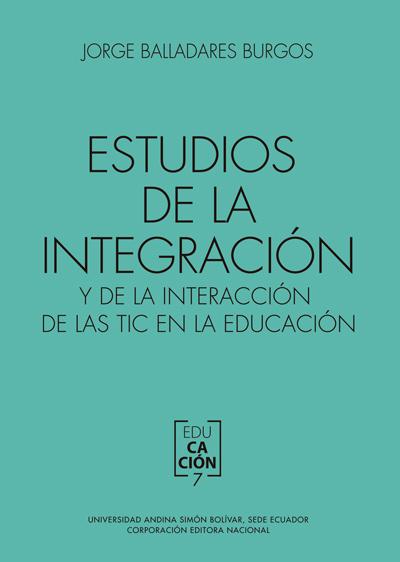
Studies on the integration and use of ICT in education
Keywords:
integration, TIC, education, Innovation, pedagogySynopsis
This book presents two studies on the relationship between information and communication technologies (ICT) and education. The first examines the integration of ICT into teacher training based on the TPACK techno-educational model. In the wake of the COVID-19 pandemic, there has been a noticeable adaptation of ICT to teaching processes, with teachers playing a key role. The second study presents findings on the technology-mediated relationships and interactions among members of the educational community based on the theoretical model of the Community of Inquiry (CoI) through its three dimensions: cognitive, social, and instructional. It is hoped that both studies will contribute to improving teacher education and professional development programs in incorporating these resources into daily classroom practice. This work serves as an invitation for educational institutions to promote the development of teachers’ digital competencies in their teacher education programs and to leverage technology to strengthen and expand educational processes in the post-pandemic era.
Downloads
References
Aguilar, Floralba, coord. 2019. Enfoques y perspectivas del pensamiento pedagógico latinoamericano. Quito: Abya-Yala.
Akyol, Zehra, Norm Vaughan y Randy Garrison. 2009. «The impact of course duration on the development of a community of inquiry». Interactive Learning Environments 19 (3): 231-46. http://dx.doi.org/10.1080/10494820902809147.
Amezcua, Angélica, Anel Brandl, Evelyn Durán y Estrella Rodríguez. 2021. «The switch to remote instruction in Spanish heritage language courses: Why social presence matters». E-JournALL, EuroAmerican Journal of Applied Linguistics and Languages 8 (2): 185-214. http://doi.org/10.21283/2376905X.14.249.
Anderson, Terry, Liam Rourke, Randy Garrison y Walter Archer. 2001. «Assessing teaching presence in a computer conference context». Journal of Asynchronous Learning Networks 5 (2): 1-17.
Arbaugh, J. B., Arthur Bangert y Martha Cleveland-Innes. 2010. «Subject matter effects and the Community of Inquiry (CoI) framework: An exploratory study». The Internet and Higher Education 13 (1-2): 37-44.
Arbaugh, J. B., Martha Cleveland-Innes, Sebastian Diaz, Randy Garrison, Philip Ice, Jennifer Richardson y Karen Swan. 2008. «Developing a community of inquiry instrument: Testing a measure of the Community of Inquiry framework using a multi-institutional sample». The Internet and Higher Education 11 (3-4): 133-6. https://doi.org/10.1016/j.iheduc.2008.06.003.
Balbo, Josefina. 2008. Formación en competencias investigativas, un nuevo reto en las universidades. Universidad Nacional Experimental del Táchira. http://www.ucv.ve/fileadmin/user_upload/vrac/documentos/Curricular_Documentos/Evento/Ponencias/Balbo__josefina.pdf.
Balladares, Jorge. 2017. «Una ética digital para las nuevas generaciones digitales». Revista PUCE, 104. https://bit.ly/2qUeJzl.
––––. 2018. «Diseño pedagógico de la educación digital para la formación del profesorado». RELATEC. Revista Latinoamericana de Tecnología Educativa 17 (1): 41-60. doi:10.17398/1695-288X.17.1.41.
––––. 2020. «Una educación remota en tiempos de contingencia académica». Andina 2 (II semestre): 29-35. http://hdl.handle.net/10644/7399.
––––. 2021. Educación digital y formación del profesorado en modalidad semipresencial y virtual (b-learning y e-learning). Estudios de caso. Quito: Universidad Andina Simón Bolívar, Sede Ecuador / Corporación Editora Nacional.
Balladares, Jorge, y Jesús Valverde. 2022. «El modelo tecnopedagógico TPACK y su incidencia en la formación docente: una revisión de la literatura». RECIE. Revista Caribeña de Investigación Educativa 6 (1): 63-72. https://doi.org/10.32541/recie.2022.v6i1.pp63-72.
Bangert, Arthur. 2009. «Building a validity argument for the community of inquiry survey instrument». Internet and Higher Education 12 (2): 104-11.
Boyer, Ernest. 1990. Scholarship reconsidered: priorities of the Professoriate. Nueva Jersey: Carnegie Foundation for the Advancement of Teaching.
Cabero, Julio, Verónica Marín y Carlos Castaño. 2015. «Validación de la aplicación del modelo TPACK para la formación del profesorado en TIC». @TIC. Revista d´innovació educativa (Universidad de Valencia): 13-22.
Camacho, Maria, Martin Valcke y Katherine Chiluiza. 2017. «The effect of “research based learning activities” on students’ intention to do research in graduate courses». EduLearn 17 Proceedings, 6571-9. http://www.doi.org/10.21125/edulearn.2017.2497.
Chai, Ching, Joyce Koh y Chin-Chung Tsai. 2013. «A review of technological pedagogical content knowledge». Education Technology and Society 16 (2): 31-51.
Cleveland-Innes, Martha, y D. R. Garrison, eds. 2010. An Introduction to Distance Education: Understanding Teaching and Learning in a New Era. Londres: Taylor & Francis.
Cobo, Cristóbal, y John Moravec. 2011. Aprendizaje invisible. Hacia una nueva ecología de la educación. Barcelona: Publicacions i Edicions de la Universitat de Barcelona.
De Marzio, Darryl. 2017. «Matthew Lipman’s Model Theory of the Community of Inquiry». Analytic Teaching and Philosophical Praxis 38 (1): 37-46.
Dunlap, Joanna, y Patrick Lowenthal. 2014. «The power of presence: Our quest for the right mix of social presence in online courses». En Real life distance education: Case studies in practice, editado por A. A. Piña y A. P. Mizell, 41-66. Greenwich, CT: Information Age Publishing.
Esquivel, Ismael. 2014. Los modelos tecno-educativos, revolucionando el aprendizaje del siglo XXI. Veracruz: Universidad Veracruzana.
Fernández-Sánchez, Rosa, y Jesús Valverde-Berrocoso. 2014. «A community of practice: An intervention model based on computer supported collaborative learning». [Comunidades de práctica: un modelo de intervención desde el aprendizaje colaborativo en entornos virtuales]. Comunicar XXI (42): 97-105. https://doi.org/10.3916/C42-2014-09.
Garrison, D. R., y T. Anderson. 2003. E-learning in the 21st century: A framework of research and practice. Londres: Routledge Falmer.
Garrison, Randy, Terry Anderson y Walter Archer. 2000. «Critical Inquiry in a Text-based Environment: Computer Conferencing in Higher Education». The Internet and Higher Education 2 (2-3): 87-105. doi:http://dx.doi.org/10.1016/S1096-7516(00)00016-6.
––––. 2001. «Critical Thinking and Computer Conferencing: A Model and Tool to Access Cognitive Presence». American Journal of Distance Education 15 (1): 7-23. doi:http://dx.doi.org/10.1080/08923640109527071.
––––. 2010. «The First Decade of the Community of Inquiry Framework: A retrospective». The Internet and Higher Education 13 (1-2): 5-9. doi:http://dx.doi.org/10.1016/j.iheduc.2009.10.003.
Gill, Lincoln, y Barney Dalgarno. 2017. «A qualitative analysis of pre-service primary school teachers’ TPACK development over the four years of their teacher preparation programme». Technology, Pedagogy and Education 26 (4): 439-56. https://doi.org/10.1080/1475939X.2017.1287124.
Goda, Yoshiko, y Masaroni Yamada. 2013. «Application of CoI to design CSCL for EFL online asynchronous discussion». En Educational communities of inquiry: Theoretical framework, research and practice, editado por Z. Akyol y D. R. Garrison. Hershey, PA: IGI Global.
Harris, Judith B., y Mark J. Hofer. 2017. «“TPACK Stories”: Schools and School Districts Repurposing a Theoretical Construct for Technology-Related Professional Development». Journal of Research on Technology in Education 49 (1-2): 1-15. DOI:10.1080/15391523.2017.1295408.
Hermann, Andrés. 2011. «Pedagogía del ciberespacio». Sophia, colección de Filosofía de la Educación 11 (2): 123-74. doi:10.17163/soph.n11.2011.04.
Huggins, Richard, Alan Jenkins y David Scurry. 2007. Undergraduate research in selected US Universities. Report on US Visit. Institutional Case Studies. Oxford Brookes University.
Kiray, Seyit, Ismail Çelik y Mustafa Çolakoğlu. 2018. «TPACK Self-efficacy perceptions of science teachers: A structural equation modeling study». Egitim ve Bilim 43 (195): 253-68. https://doi.org/10.15390/EB.2018.7538.
Koh, Joyce, y Ching Chai. 2014. «Teacher clusters and their perceptions of technological pedagogical content knowledge (TPACK) development through ICT lesson design». Computers & Education 70: 222-32.
––––, Ching Chai y Lee Tay. 2014. «TPACK-in-Action: Unpacking the contextual influences of teachers’ construction of technological pedagogical content knowledge (TPACK)». Computers & Education 78: 20-9.
––––, Ching Chai y Wei Ying Lim. 2017. «Teacher Professional Development for TPACK-21CL: Effects on Teacher ICT Integration and Student Outcomes». Journal of Educational Computing Research 55 (2): 172-96. https://doi.org/10.1177/0735633116656848.
Krauskopf, Karsten, Teresa Foulger y Mia Kim Williams. 2018. «Prompting teachers’ reflection of their professional knowledge. A proof-of-concept study of the Graphic Assessment of TPACK Instrument». Teacher Development 22 (2): 153-74. https://doi.org/10.1080/13664530.2017.1367717.
Kumar, Swapna, Kara Dawson, Erik Black, Catherine Cavanaugh y Christopher Sessums. 2011. «Applying the community of inquiry framework to an online professional practice doctoral program». The International Review of Research in Open and Distance Learning 12 (6): 126-42.
Laurillard, Diana. 2002. «Rethinking Teaching for the knowledge society». Educause Review 1 (37): 16-25.
Lipman, Mathew. 1991. Thinking in education. Cambridge, UK: Cambridge University Press.
Lodico, Marguerite, Dean Spaulding y Katherine Voegtle. 2010. Methods in Educational Research: from Theory to Practice. San Francisco, CA: Jossey-Bass.
Lowenthal, Patrick, y Joanna Dunlap. 2014. «Problems Measuring Social Presence in a Community of Inquiry». E-Learning and Digital Media 11 (1): 19-30. https://doi.org/10.2304/elea.2014.11.1.19.
Mishra, Punya, y Matthew Koehler. 2006. «Technological Pedagogical Content Knowledge: a framework for teacher knowledge». Teachers College Record 108 (6): 1017-54.
Mouza, Chrystalla, Rachel Karchmer-Klein, Ratna Nandakumar, Sule Yilmaz Ozden y Likun Hu. 2014. «Investigating the impact of an integrated approach to the development of preservice teachers’ technological pedagogical content knowledge (TPACK)». Computers & Education 71: 206-21.
Payne, Carla. 2009. Information Technology and Constructivism in Higher Education: Progressive Learning Frameworks. Nueva York: Information Science Reference.
Pérez Gómez, Ángel. 2010. «Aprender a educar. Nuevos desafíos para la formación de docentes». Revista Interuniversitaria de Formación del Profesorado 68: 37-60.
Pérez Serrano, Gloria. 2003. Pedagogía social, educación social. Madrid: Narcea.
Petticrew, Mark, y Helen Roberts. 2012. Systematic reviews in the social sciences: a practical guide. Malden, Mass.: Blackwell.
Richardson, Jennifer, y Patrick Lowenthal. 2017. «Instructor Social Presence: Learners’ Needs and a Neglected Component of the Community of Inquiry Framework». En Social Presence in Online Learning: Multiple Perspectives on Practice and Research, editado por A. Whiteside, A. Garrett y K. Swan, 32-44. Sterling, Virginia: Stylus Publishing.
Ripa, María Estela. 2007. «¿Cómo abordar el estudio de una comunidad de aprendizaje blended learning?». Teoría de la Educación. Educación y Cultura en la Sociedad de la Información 8 (3): 200-22. https://www.redalyc.org/articulo.oa?id=201017307011.
Saengbanchong, Varongsri, Nonglak Wiratchai y Suchada Bowarnkitiwong. 2014. «Validating the Technological Pedagogical Content Knowledge appropriate for instructing Students (TPACK-S) of pre-service teachers». Procedia - Social and Behavioral Sciences 116: 524-30.
Schmidt, Denise, Evrim Baran, Ann D. Thompson, Punya Mishra, Matthew J. Koehler y Tae S. Shin. 2009. «Technological pedagogical content knowledge (TPACK): The development and validation of an assessment instrument for preservice teachers». Journal of Research on Technology in Education 42 (2): 23-149.
Shea, Peter, y Temi Bidjerano. 2010. «Learning presence: Towards a theory of self-efficacy, self-regulation, and the development of a communities of inquiry in online and blended learning environments». Computers and Education 55 (4): 1721-31.
Shulman, Lee. 1987. «Knowledge and teaching: foundations of the new reform». Harvard Educational Review 57.
Siemens, George. 2004. Conectivismo: una teoría de aprendizaje para la era digital. Bogotá: Universidad de los Andes.
Swan, Karen, Jennifer Richardson, Phillip Ice, Randy Garrison, Martha Cleveland-Innes y J. B. Arbaugh. 2008. «Validating a measurement tool of presence in online communities of inquiry». E-Mentor 2 (24). http://urn.kb.se/resolve?urn=urn:nbn:se:kth:diva-70284.
––––, Randy Garrison y Jennifer Richardson. 2009. «A constructivist approach to online learning: The community of inquiry framework». En Information technology and constructivism in higher education: Progressive learning frameworks, editado por C. R. Payne. Hershey, PA: IGI Global.
Teague, Helen. 2017. A mixed methods study of online course facilitators’ perceptions of mobile technology, design, and TPACK affordances. Available from ProQuest Central. (1889540301). https://search.proquest.com/docview/1889540301?accountid=36797.
Teng Lye, Lau. 2013. «Opportunities and challenges faced by private higher education institution using TPACK Model in Malaysia». Procedia - Social and Behavioral Sciences 91: 294-305.
Thai, Thuy, Bram De Wever y Martin Valcke. 2015. «The impact of a Flipped Classroom design on Learning Performance in Higher Education». Computers & Education 107: 113-26.
The Design-Based Research Collective. 2003. «Design-Based Research: An Emerging Paradigm for Educational Inquiry». Educational Researcher 32 (1): 5-8.
Tian, T., N. Zou, J. Jiang y X. Xu. 2017. «Application of practical curriculum for college specialty of economic management under TPACK framework: Taking “enterprise operation and decision simulation system” curriculum as an example». International Journal of Emerging Technologies in Learning 12 (7): 124-35. https://doi.org/10.3991/ijet.v12i07.7223.
Tomte, C., A. Enochsson, U. Buskqvist y A. Karstein. 2015. «Educating online student teachers to master professional digital competence: the TPACK-framework goes online». Computers & Education 84: 25-35.
UNESCO. 2016. Innovación educativa. Lima: UNESCO. https://unesdoc.unesco.org/ark:/48223/pf0000247005.
Valverde, Jesús. 2011. «Profesorado, tecnología educativa e innovación didáctica». En Docentes ecompetentes: buenas prácticas educativas con TIC, 13-28. Barcelona: Octaedro.
––––. 2014. La definición del tema de investigación. Plan de Formación de Doctores en Tecnología Educativa. Cáceres: Universidad de Extremadura.
––––, Carmen Garrido y Rosa Fernández. 2010. «Enseñar y aprender con tecnologías: un modelo teórico para las buenas prácticas con TIC». TESI (Universidad de Salamanca) 11 (3): 203-29.
––––, y Jorge Balladares. 2017. «Enfoque sociológico del uso del b-learning en la educación digital del docente universitario». Sophia: Colección de Filosofía de la Educación 23 (2): 123-40.
Vaughan, Norm, y Randy Garrison. 2019. «How blended learning can support a faculty development community of inquiry». Online Learning 10 (4). doi:http://dx.doi.org/10.24059/olj.v10i4.1750.
Wang, Feng, y Michael Hannafin. 2005. Design-based research and Technology-Enhanced Learning Environments. ETR&D 53 (4): 5-23.
Published
Series
Categories
License

This work is licensed under a Creative Commons Attribution 4.0 International License.
You are free to:
- Share: copy and redistribute the material in any medium or format for any purpose, including commercial purposes.
- Adapt: remix, transform, and build upon the material for any purpose, including commercial purposes.
- The licensor cannot revoke these freedoms as long as you comply with the terms of the license.
Under the following terms:
Attribution: You must give appropriate credit, provide a link to the license, and indicate if changes were made. You may do so in any reasonable manner, but not in a way that suggests the licensor endorses you or your use.
No Additional Restrictions: You may not apply legal terms or technological measures that legally restrict others from doing anything the license permits.
Notices:
You do not need to comply with the license for elements of the material that are in the public domain or where your use is permitted by an applicable exception or limitation.
No warranties are provided. The license may not grant you all the permissions necessary for your intended use. For example, other rights, such as publicity, privacy, or moral rights, may limit your use of the material.